Latest Update of this Site: September 21, 2026
Remark 1: Ingo Althöfer himself is also working
on the original Collatz problem, with the help of
systems like Astra 6.0. Please, do not send you
own proof attempts for the problem.
Remark 2: Computer-assisted proofs are fine, as
long as they are CORRECT! One warning: Sometimes newbies
to AI-assisted math make the mistake to use only
mathematically weak LLm's or systems in "instant"-
or "flash"-modes. The resulting output is often
full of hallucinations or errors.
Collatz Prizes offered by Ingo Althofer
The following problem, first stated by Lothar Collatz
back in 1937, is wellknown:
Start with an odd number n. Build 3n+1, and then half on this
until finally an odd number is reached again. For short we describe
this step by odd(3n+1).
Repeat this loop until either 1 is reached or until you lose interest.
The Collatz conjecture says that for each starting value n after
finitely many steps 1 is reached. A formal proof is still missing.
We want to motivate people to think more deeply on this problem
and some variants. Therefore, we offer a few money prizes.
Prize 0 - updated on September 07, 2026
Look at the following stochastic variant of the Collatz Problem:
When some odd number n is given, flip a fair coin, independently
of history, and according to the outcome do the following:
* odd(3n+1)
or
* odd(3n-1) (means: build 3*n -1 and make "down-halving")
Iterate the procedure with the new values of n.
Observation: If 1 is reached at some point, the
sequence will stay there forever.
Conjecture: For every starting value of n
the procedure converges to 1 with probability 1.
For the first proof of the conjecture before December 31,
2037, I offer 300,- Euro.
The related question of Prize 0 with odd(3n+1) and odd(3n+3) (both with prob 1/2)
instead of odd(3n-1) and odd(3n+1) has a simple proof for the statement
that for each starting value n
the target n=1 is reached with prob 1 earlier or later.
Known is also this result for a mixed stochastic variant:
Each round has two steps. In step 1 odd(3n+7) and odd(3n+9)
are selected both with probability 1/2. In step 2 odd(3n-1)
and odd(3n+1) are selected both with probability 1/2. For each
odd starting value n > 1,000 the region below 1,000 is reached
with probability 1.
Explanation: The model with only odd(3n+7),odd(3n+9) is a simple
one. The model with odd(3n-1),odd(3n+1) is the hard one. Mixing
them in this regular way is enough for "convergence". Likely k-step
rounds with k-c many odd(3+-1) steps and c many odd(3n+7)/odd(3n+9)
steps will also be provable for several c=o(k).
* The 5n+1 problem is almost identical to the 3n+1 problem.
The only difference is that instead of 3n+1 the expression 5n+1 is built.
Analogously, in the X*n+1 problem the expression 3*n+1 is substituted by X*n+1.
Prize 1
Prove or disprove that there exists some odd number
X larger or equal to 5 and an odd
number n(0), such that starting value n(0) leads to infinity under the rule
n(t+1) = X*n(t) + 1 and subsequent halfing. (25 Euro)
Prize 2
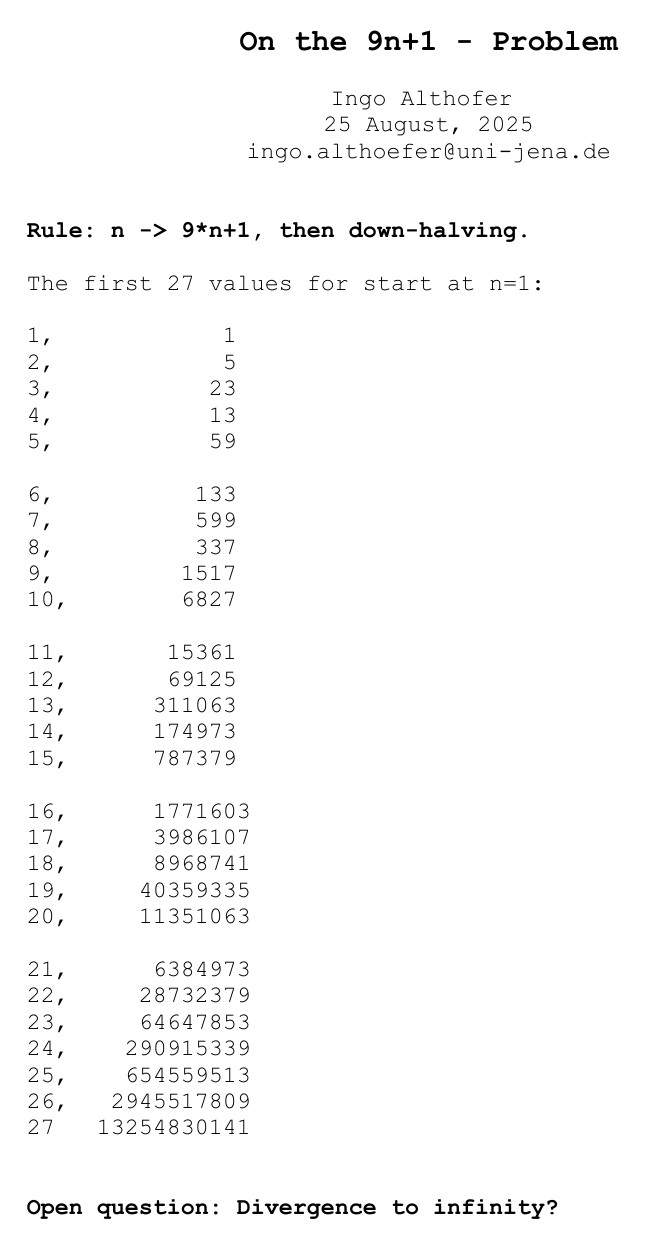
Prove or disprove that n(0) = 1 leads to infinity under the rule
n(t+1)= 9*n(t) + 1 and subsequent halfing. (50 Euro)
Prize 3 - Updated on August 08, 2026
This prize concerns a 2-player game with alternating move order.
The current state in the game is an odd number n.
The player to move builds either 3n+1 or 3n-1. Then
iterative halfing is done, until an odd number is reached again.
If this new number is 1, the player has won the game. If not,
the other player is to move. Observe: the player to move
has only the choice between two options.
Computer analysis by Michael Hartisch has shown that in case
of optimal play by both players, the game will end in 1, when
started in a position with a number n < 1 million.
A prize of 500 Euro is offered for a proof that all
odd starting numbers n will lead to 1, if both players
act optimally.
Grisha Pochuev sent me a manuscript with a claimed proof
for this problem. It looks promising, but checking the details
will take quite some time. Sept 07, 2026: Checks are still underway.
For short, we call the game "the 3n+-1 game".
The game was created in July 2023 by Ingo Althofer.
Main Prize
Prove or disprove the original Collatz conjecture:
All n(0) lead to 1 after finitely many steps in
the 3n+1 problem. (1,000 Euro)
If the problem is undecidable, a proof of
undecidability qualifies also for the prize.
Until recently I was convinced that a proof before the end of
2037 would come unexpected. But now in times of ChatGPT 5.6
and perhaps even stronger AI-agents (Astra 6.0 ?!) following up a proof within
the next few years seems to be possible. (Remark added on August 08
and September 07, 2026.)
************************************
Prizes only for solutions submitted until December 31, 2037.
Prizes only for first solutions for that question.
Payment of prize moneys with PayPal. If that is not possible
for the country of a winner, we will find an alternative route
for the money tansfer.
Legal actions are excluded. Writing this sentence I have
in mind mainly situations where an erroneous proof is submitted.
Solutions of prize problems are mentioned on this website. If
a prize winner agrees, also his or her proof will be presented here.
*********************************************
*********************************************
Recently Ingo Althöfer achieved a counter-example for a
natural variant of the Collatz problem:
Here is a generalized model: Given real parameters (x,y) with 1 < x < 2 and y > 0, the
recursion rule for odd number n is:
x*n + y is downrounded, and halving is done until an odd number is reached. This is the new n.
The model for x = 3/2 and y = 0 is equivalent to the 3n-1 problem.
The model for x = 3/2 and y = 1/2 is equivalent to the 3n+1 problem.
For x = square-root(2) and y = 4, the sequence starting at n=1 diverges to infinity.
Download of the Preprint.
News and updates on these prizes on the website
Contact: ingo.althoeferCOLLATZuni-jena.de
You know what you have to substitute to get a real address.
Back to the main site of Ingo Althöfer